
Lesson Plans! Lesson Plans! Lesson Plans! Instructing children requires some planning. And, I’m a very firm believer that tutoring can’t be effectively or efficiently performed by “flying by the seat of your pants.” It has to be structured in order to get the most out of each session you have with a child.
Most tutors have a set and limited amount of time with each student. For me, when I worked for the tutoring company, I only had 15-minute sessions with children. (Imagine how easily I could waste my and the student’s time if I didn’t come prepared and ready to get after it, optimizing every second I could squeeze out of that sprint session.)
And now, tutoring through my own business, I’ve opted for longer sessions (since I have a choice), because I just need more time to spend in instructing a child. My sessions can run 30 minutes to an hour, but usually they’re in the 45-minute range. That’s my sweet spot for tutoring. In my experience, 45 minutes gives you enough time to greet your student, do some skills work and enrichment, and to get in a little reading coaching and goal-setting — all of which I like to do each session with my kiddos.
And even with that additional time added on to the very limited 15 minutes I used to have, I still find that the time flies by SO INCREDIBLY FAST! So, organization and structure are required in longer sessions, as well. Discipline, too. Because, it can be so easy to slide into a visiting with your student WAY TOO MUCH mode when you know you have 30, 45, or 60 minutes to play with in a tutoring session.
Planning is required! So, do your homework!
There are so many benefits to planning for the tutor. Let me count some of the ways:
- Writing down simple lesson plans keeps you on track with a tutoring session, so you don’t have to rely on the old noggin (especially when that old noggin is subject to leaving some important parts of the instruction out).
- In sticking with the “keeping on track” statement above, you may not always get through everything in your lesson plan, depending on what goes on during a session. So, you can check off the items you get done for that session on your written lesson plans, and then, what you don’t check off will be what you can start with next session. Plans are a great tracker for where a session ended and where it needs to start the next time.
- You have documentation on what was covered during a session. You can use the documentation to report to the child’s parent(s) (or whoever needs to be reported to) what was covered, so the parent(s) can be in the loop on the child’s reading skills development journey.
- Planning leads to organization and structure, and children need that when they are learning new and/or difficult things. A child who may already be struggling in a subject (such as reading) needs all the certainty he or she can get. And an educator coming to a session unprepared, scattered, and unsure of what he or she is doing surely doesn’t set an educationally impressionable young mind at ease. (Organized skills building blocks are necessary to help a child “connect the dots” when it comes to skills growth.)
- You have records of the progression of a child’s journey and can see what areas he or she has mastered and what areas he or she is still struggling with. (I make notes with my lesson plans on how things went with certain skills that were covered — to help track the reading progression of the student.)
I could probably come up with a few more pros (can’t think of any cons) to planning for tutoring sessions, but I can stop with what’s been presented thus far. I think I’ve made my case for the importance of being prepared for tutoring a child. Plus, it’s just common sense. I mean . . . I ask my student to come prepared, so why wouldn’t I do the same?
Now, as far as the template for a lesson plan, I keep it very simple. I’ve just created a template that I use for each student according to the days of the week that I meet with the child. It includes the child’s name, the days of the week for the tutoring sessions (I write the actual dates next to the days of the week), boxes to check off showing the action item was completed, lines to write whatever I need to write for the action item to be covered, and a “Notes” section. See example below.
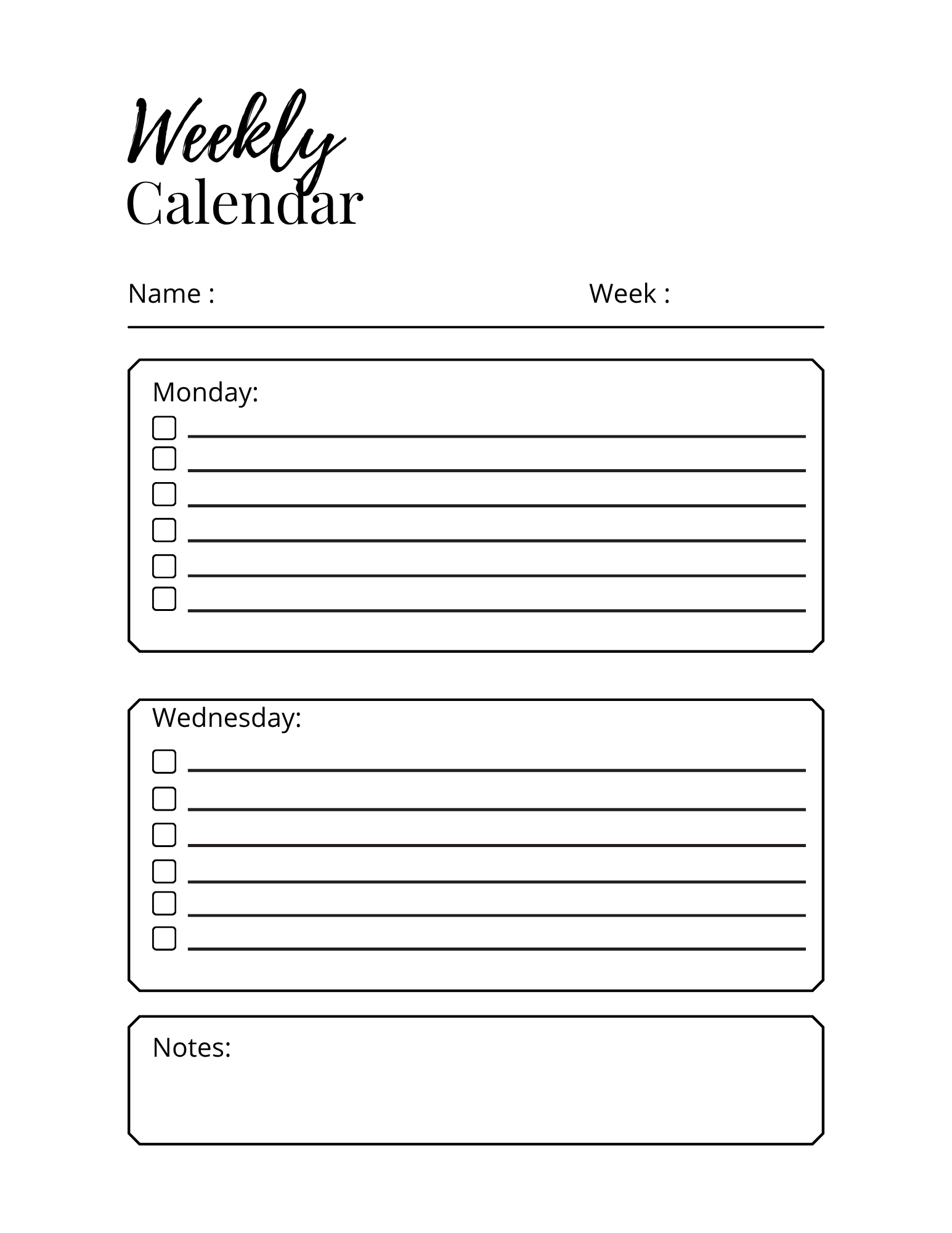
Very simple. It works for me. But, I’ll tell someone in a heartbeat to “Do YOU!” Creating an optimized (for your purposes) DIY template that includes all the pieces you need for planning is what’s important, not how it looks. So, go for it! Or, there are notebooks and planners you can purchase that will work just the same if you’d rather work with something readymade.
Let me just conclude by saying that I’m a writer, so writing down plans with good old paper and pen is pretty natural to me. There’s just something enjoyable about the process, but I’m a tactile person. So, that makes sense. You may not want to write everything down when planning. Maybe you’d prefer to type out your notes on a device of your choice — NO PAPER ALLOWED! That’s perfectly fine, too. Again, do what works for you and helps you organize, structure things, and plan in the fashion that gets you the results you need.
NOTE: I actually DO end up typing out (and saving on my computer) what was actually covered during a child’s tutoring session. And, this copy is the breakdown of events in a “Weekly Progress Report” that I email to interested parties.
There’s definitely more than one way to plan. Just take on the planning format that will help you get the job done and maximize those precious minutes you have with your tutee during your tutoring sessions.
On to day 4!

 degreesofmaternity.com