
Well, you had to know that I couldn’t leave my other creative relationship out of the loop. If I gave you a blog post about reading activities (which I did in last week’s blog post, entitled 7 Reading Engagement and Enrichment Activities for Children), then you had to have known I would show up with a writing activities feature.
And, here it is — all prepared for you to review and see what you can use with your child or a child you know. Please note that making literacy an enjoyable (or at least, tolerable) experience for children may require thinking outside of the box of limitations we may be used to when it comes to reading and writing.
Let’s make literacy learning interesting and something children want to engage with every chance we can get. It makes a child’s buy-in to the literacy learning process so much easier.
Check out the following writing activity suggestions for children (in no particular order):
Activity #1
Buy some fun-themed stationery and envelopes that you know your child will like visually. And have him or her practice mailing letters to friends and/or family. This idea would be a great school break activity for your child, especially when he or she may want to keep in touch with friends or relatives who live far away. Of course, today, it’s so easy to simply communicate to someone by a phone call, text message, or email; but there’s something incredibly special in receiving a handwritten letter or card in the mail from someone. The extra effort put into such an activity is a rarity these days and usually appreciated by the receiver as something uniquely out of the norm.
Activities, such as writing out a handwritten message in a card or a letter, obviously, help to get the writing juices flowing in a real-life application setting. Furthermore, it’s important for younger children to physically write out (not type up) the message because this writing practice forces him or her to use handwriting motor skills, which are critical to perfecting letter (as in the ABCs kind of letter, not the mailing kind of letter) formation at a young age. And once your child is comfortable with the foundational skill of writing uppercase and lowercase letters in their correct forms, then you can feel free to have him or her develop keyboarding skills by typing out (instead of handwriting) correspondence sent by mail.
Activity #2
Have your child write up the most fun, unique, wacky, crazy edible recipe that his or her lively imagination can drum up. The recipe should pattern off of something that would be found in a cookbook, complete with a list of ingredients, the measurements for all the ingredients, and the step-by-step instructions for making the recipe. Then, you and your child can follow the recipe (as long as it doesn’t create any health and safety hazards to your home or everyone in it). I’ll leave it up to you and your child to decide whether or not you’re brave enough to actually taste the final outcome from your labors in the kitchen.
Activity #3
Have your child write up a print advertisement or commercial for his or her favorite toy, board game, video game, recreational activity, or entertainment venue, etc. Your child should be prepared to present the advertisement or commercial to a live audience (with you included, of course) to see if he or she can win you over to either buying or taking him or her to the item or attraction in question. (This particular activity will help your child develop persuasive writing skills and practice delivering that persuasive advertisement to others.) As a way to incentivize your child to make a creatively full-blown marketing piece, tell him or her that you intend to spend money on whatever is being advertised (if within reason) or reward your child in some other way for a job well done.
Activity #4
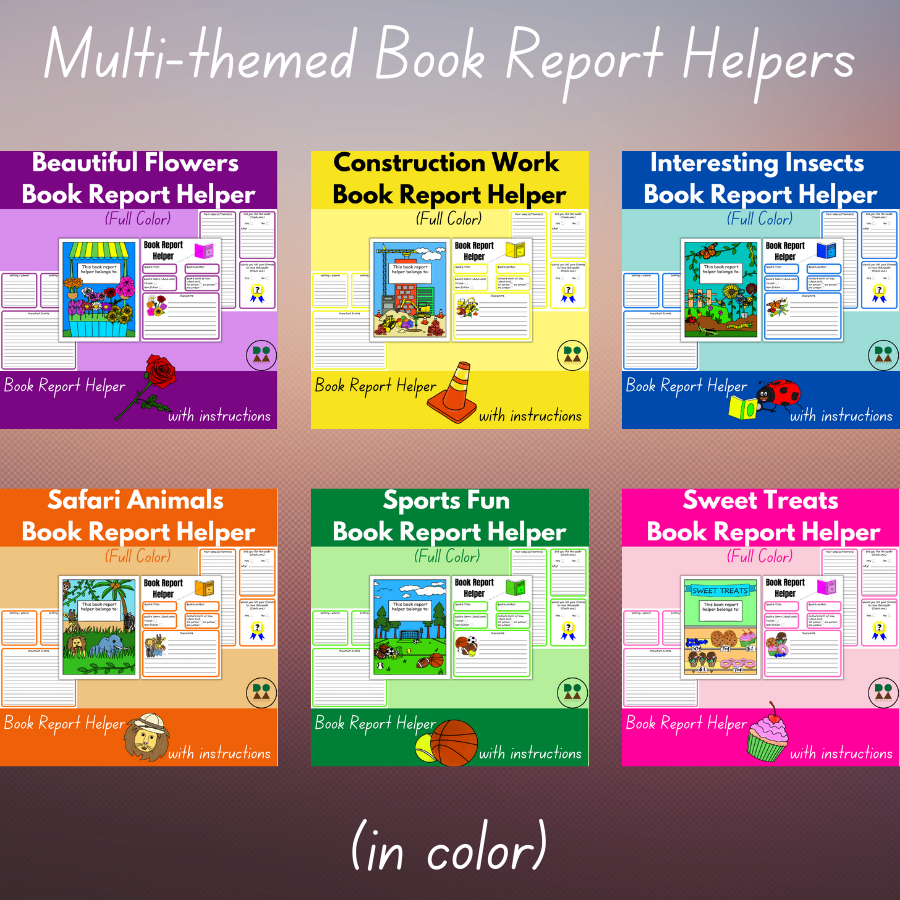
Book reports on books read for enjoyment are always a classic way to get your child to write. You could have him or her write content covering the characters, setting, plot, main idea, and moral of the story. I even have some fun tools you can use to help your child with the book report. (Click on the image below to take you to my TpT store where you can find them.) Or, you could go so far as to discard the whole “book report” method and have your child write about absolutely any topic, regarding a book he or she enjoyed reading. And even though you’re not calling it a “book report” per se, you should ask your child to cover items such as what did he or she learn from the book, what did he or she enjoy most about the book, or any old thing that will test your child’s knowledge of what was read (reading comprehension).
Make sure you’re familiar with the actual book so you can decipher whether or not your child has some sort of understanding of what was read. You might even want to make this idea a two-part activity, where you and your child orally read the book together. Then, you can assign some kind of writing assignment about the book or let your child have free rein to write anything he or she wants to about the book. Or, do a combination of both.
Activity #5
If getting words written on a page (when it comes to storytelling) is difficult for your child, try having your child tell a story out loud. And while your child is doing so, record his or her words on some type of recording device such as an actual recorder or phone. Then, have your child transcribe what was recorded on the recording device to a piece of paper. This method of getting the writing juices flowing is especially helpful for children who have a block when it comes to initially putting pen or pencil to paper. Talking ideas out verbally may be a more natural way for your child to come up with stories. (You can always add the writing element later.)
Activity #6
If your child has trouble coming up with general writing or story ideas, provide him or her with writing prompts or topics to explore. Check out some suggested topics in the journaling section (below). Another method for coming up with general writing or story ideas is to hold “brainstorming” sessions with your child. Make the brainstorming session a whole event, catering to the flow of creativity. During a brainstorming session, the most comprehensive list of topics that come to mind should be included.
Brainstorming allows your child to let his or her thought processes freely flow without editing out any of the ideas that come to mind (no matter how improbable they may seem). The whole goal of brainstorming is to create a safe haven for an uninhibited flow of creativity. Once the comprehensive list has been completed and your child has exhausted all ideas, then work with your child to whittle the list down to topics he or she would realistically enjoy writing about. And, those topics can be the ones assigned to future writing sessions. (NOTE: some children like to get direction on what to write and others don’t. Children will become more independent thinkers on writing topics as they practice writing and determine what it is they do and do not like to write about.)
Activity #7
If your child likes music, here are a few suggestions for adding a little writing to the merriment in music. Regarding rhythms, have him or her listen to favorite recorded beats or perform them and then write a song or poem to them. (Your child could even verbally recite the song while recording it and then transcribe it from the recording, if that method is preferable.) Songs and poems are excellent artistic forms that incorporate writing, using very rhythmic undertones. You could even have your child pick his or her favorite song, keeping the melody and beat to it, but have him or her switch out the words with original lyrics to create a whole new song. Furthermore, you can create an open mic night and have your child create a song (write it out lyrically and memorize it) and then perform it before family and friends. (And don’t forget to video record such a special occasion so you and your child can enjoy the performance over and over again.)
Activity #8
Give your child a basic sentence/story and then enhance it by adding details to the sentence or the story. To give you an idea of where you can have your child add the details, try sprucing up the characters, setting, and plot of the story with specifics. (Think: adding adjectives as descriptive words for nouns, adverbs as descriptive words for verbs, and prepositional phrases to identify where and when something is taking place).
Or, you could even get down to the basic level of having your child enhance a sentence that he or she wrote by taking that sentence and adding specifics that address who, what, where, when, why, how/how much/how many, and which/which one questions. Take the following sentence as an example: The boy ate sandwiches. This sentence is very basic, so I’m going to detail it up a bit. Here’s my new sentence with all the added wording in bold letters: The tall boy from my class ate two peanut butter and jelly sandwiches today during lunchtime, because he didn’t want to eat the school lunch that includes broccoli every Friday. Now, out of the two sentences, which one brings more of the storytelling element to life? And can you tell some of the question words I answered to bring out the details of my basic sentence?
Activity #9
Take turns creating a handwritten story with your child. Where you leave off is where your child will come in and vice versa. You will both be responsible for writing alternating portions of the story. Offer to have your child start the story off; but if he or she has trouble initiating the storyline, then you can start it out and have your child add to it and keep going back and forth until you both come to an ending that you’re satisfied with. This project can take place in one day or over multiple days.
Activity #10
Have your child keep a journal or diary. Tell him or her to write anything he or she wants in as little or as much wording as is needed. But, put out there that you have the expectation that the journal will be written in daily. Journaling forms a habit of writing (the important point to keep in mind), even if your child doesn’t write a whole lot in the journal or write with correct sentence structure and without grammatical errors. Feel free to give your child some ideas of what he or she can write about. The topics can be based really on anything that comes to your child’s mind. And, each page of the journal should be dated chronologically. I guarantee that at some point when your child decides to look back on the journal, he or she will get a kick out of what was being thought, done, or written about at different times in his or her life. The following are possible journal topics or writing prompts that you can provide to your child:
-
- your child’s favorite video game character or create a video game character and describe what that character looks like and what it will be able to do in the game
- your child’s favorite activity (inside or outside of the home)
-
- your child’s best day ever
- what your child’s most delicious meal is or would look like
- your child’s favorite superhero or someone who he or she admires
- what your child’s superpower would be and how it would be used
- what motivates/inspires your child
- your child’s favorite vacation memory or somewhere your child would like to go on vacation (a classic writing activity)
- what your child wants to be when he or she grows up (another classic writing activity)
- what your child would do with his or her money (if there were unlimited amounts of it)
- a day in the life of your child
If your child loves to create artwork, let him or her custom design the journal to his or her liking. If your child could care less about the aesthetics of the journal, then any notebook or loose-leaf stack of paper in a binder or report cover will do. The emphasis of this activity is placed on the fact that your child is writing and not on the look of the repository the writing is held in.
Activity #11
Have your child participate in writing sprints — not necessarily for quickness’ sake but to break down writing sessions into shorter periods that your child can repeat multiple times a day throughout the day. That way, the task of writing doesn’t seem as daunting. 10-15 minutes tended to be the sweet spot for my son when he was younger, but do what works for your child. The whole purpose of this sprint is to encourage uninterrupted writing activity, while preventing the writing sessions from becoming too lengthy. When you start getting diminishing returns (where your child is tired, uninterested, has no motivation to proceed), then you know you’re running too long. Shorten the writing sessions (but maybe do more of them throughout the day), so your child gets the most out of his or her writing time.
Whew!!! This was a long one, so I think I’ll end here. But, I sure hope you received some writing inspiration to take along with you and use when some extra motivation may be needed to incentivize a child to write.
Until next time . . .


Hey there Phil – I am SO HAPPY to hear that you got your book published! What an accomplishment! And kudos to you. About a hundred copies of your book is about a hundred copies of your book. Woo hoo! I think that’s absolutely great! And, I do pray that you are feeling better, Phil. Please do take care of yourself. Oh yes, I’m trying to remember to “SIMPLIFY” because I just need to keep from overwhelming myself with everything that life can throw in your path. Some is for the taking and other stuff isn’t. It’s easy to get caught up in trying to do ALL THE THINGS. But, I’m trying to resist. However, easier said than done because I just added another to-do to my long list of to-dos. (This to-do is a fun one, though — that is . . . to read your book.) Just ordered it from Amazon. I’m so excited to get to read it. Should be on my doorstep first of next week! Thanks for inspiring with your actions and your words. And, please take care of yourself.
LikeLike
Yana. Thanks for getting back to me – it is always appreciated.
Sorry for not getting back to you regarding my book – When Times Were Tough. It has not been taken up by any
major retailers since I published it myself, so I have only sold about a hundred copies. It is a very difficult process to get a
self published book into the “system”. I gave up doing anything more about it at the end of last year and I have moved on since.
I have not had the best of health outcomes recently, so there are no new projects at this stage, although the near future is improving.
The important thing to do is accept what live throws at you, make informed decisions and move on. I have moved on.
I am glad that your husband thinks you are a “good girl”, but then again I am having to take your word for that!
All the best with your recent endeavors. As I have said before, don’t forget to “never take on more than you can chew”.
Regards, Phil
LikeLiked by 1 person
Oh, thank you Phil. Yes, I was trying to think outside of the box for some stimulating activities for children. But, you never know. Even if you don’t have youngins to share these with, there might be some of these writing activities you can take on yourself or share with another adult. I think I’m going to try a few with my 9th grader before school starts back up for him. We’ll see. He’s enjoying getting his sleep these days. I think all that sleep he’s taking in is helping him grow by leaps and bounds and is working towards helping him catch up with his brother who’s over 6 feet. But speaking of adults doing writing activities, please let me know how your book writing efforts are going. I haven’t had an update from you for a while. I sent you a recent email asking about your book, but you may not have seen it yet. I think you mentioned a past email of mine (to you) may have gone to your spam inbox. So, make sure you check there if it didn’t ever land in your inbox. Anyway, please email me some time and let me know how that part of your creative life is going. Oh and of course, I’ve been a good girl (even my husband would say so), so please keep tuning in. Your presence means so very much to me. I’m always looking for your visit. You’ve got me spoiled. Have a most blessed weekend, Phil!
LikeLike
Jana. There are many excellent ideas in the 11 ideas in your activity list. I am a little past having
such young children around, but that should not affect how others can use your suggestions.
Keep up the good work, and if you are a good girl, I will read everything you send me.
Regards, Phil
LikeLiked by 1 person