This continuation of the Goal-Setting Process for work-life balance has been a long time coming. I know. But, we’re going to press on today and make some more progress in our goal planning. Step #3 of the process is what’s on the agenda, and I have some more definition to add to our goal finessing. It’s all about making our goals as SMART as they can possibly be.
If you’ve read it once, then you’ve read it twice or more on this blog. I’m a HUGE advocate of leveling up our goal-setting efforts with SMART goals. As a matter of fact, I’m hard-pressed to envision a world of successful goal setting without them.
Goals need definition. They need some detail in order to provide you with the direction needed to carry them out. It’s as simple as that. And making those goals SMART is the efficient way to set yourself up with actionable, bite-sized mini goals to lead you to your goal destination.
By the way, if you have absolutely no idea what I’m even talking about with this whole goal-setting process stuff, no worries. I’ve got you covered. Just take a small detour to brush up on my goal-setting mumbo jumbo in the two blog posts below and you should have enough background context to make today’s content more relevant.
Conquering the Creative Work-Life Balance: Goal-Setting Steps 1 and 2
Conquering the Creative Work-Life Balance: Simplify Your Goal Setting
Believe it or not, creating SMART goals truly helps to simplify the goal-setting process. It really does. I promise. And, I know how you might be internalizing the statement I just made. You’re probably saying, “Right, Jana” with a bit of sarcasm in the tone. And I’m almost certain that some of you aren’t going to believe me when I tell you that (in the long run), going the extra step by making your goals —
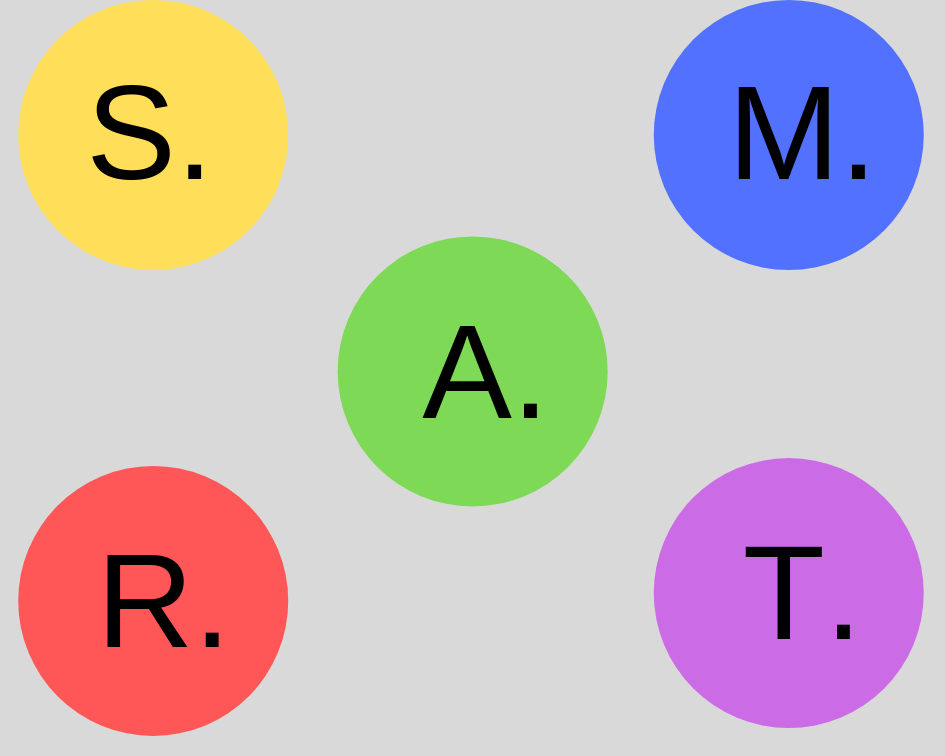
- S (Specific) – the goal has a clearly defined expectation that is communicated,
- M (Measurable) – the goal can be observed or compared and therefore assigned a number, value, amount, or estimation,
- A (Achievable) – the goal is challenging yet attainable, where the necessary resources are accessible,
- R (Realistic) – the goal has a relatable purpose and meaning to the desired outcome, and
- T (Timely) – the goal has a certain timeframe for completion or a deadline attached to it
— is truly the SMART (yes, I said it) way to go.
Now, I’m going to use the same old example I always use to pull out the point I want to make about a very basic (general) goal versus a SMART goal — because it’s a good example and why mess up a good thing when you have one? So, check out the basic goal below:
I will exercise for my health.
Now, check out how I make the basic goal (above) SMART.⇓
I will exercise to strengthen my heart by walking in the mornings (around my neighborhood or at the mall when the weather is uncooperative) for at least 5 days out of the week (Monday thru Friday) for 45 minutes to 1 hour a day.
Let me break down the SMART components of the goal above.
- Specific – exercise by walking
- Measurable – 5 mornings per week (Monday through Friday)
- Achievable – walk around the neighborhood or mall (when the weather is uncooperative)
- Realistic – walk to strengthen heart
- Timely – 45 minutes to 1 hour
Now, that’s what I’m talking about. Do you see that definition (that detail) in there that I referred to earlier? Goals absolutely need the detail. They really do. The detail is what gives you the framework in which to view your goals — one against the other — and to fit them appropriately within your daily/weekly routine or schedule. The detail is what reminds you of the “why” you’re doing the goal in the first place and whether or not it’s realistically achievable. The detail is what helps you to create benchmarks of progress and to identify the distance necessary to reach the end goal.
THE SMARTs ARE IN THE DETAILS.
And with all of the above being said, let me end by having you tie this SMART piece to Step 2 of the Goal-Setting Process, which involves the list-making. The making of four categories of lists to be exact. Let’s refresh your memory (below).
Step #2 required that you take all of your goals from your different broad, work-life categories (encompassing your personal and professional lists of to-dos) and sort them into categories based on time to goal completion:
- goals you’d like to start on immediately,
- goals you’d like to start and complete in the next month,
- goals you’d like to start and complete within 1 – 3 months, and
- goals that are more than 3 months away from probable implementation.
So, from this list of goals that are broken out into your four categories, I want you to concentrate on the goals in the first three only and start adding that SMART element that’s been emphasized over and over again in today’s discussion. It’s important, people. You’ll see why once we get into Steps #4 and #5 of the process. I guarantee.
And any goals outside of the 3 months will get tabled for now. We can come back to them right before our one month or three months is over (depending on how far into the future our goal plans extend). NOTE: make sure to keep those goals that are 3 months or more out saved in your paper or computer files somewhere so you can refer to them when the time comes.

 degreesofmaternity.com