As a parent, you won’t have much if any say in what teaching methods are presented to your children when you send them away for 7+ hours in a day. You do, however, have control over what you expose your child to within the confines of your own home. Whether homeschooling or not, it’s important to be involved in your child’s formal education.

But, check out this scenario. Wonder if you currently have your own version of a Toodlez (my daughter) or Junior (my oldest son), who either have or will have completed college coursework in subjects such as Calculus III and Physics for Engineers, for example? And wonder if you know for an absolute fact that your ability to provide them with any type of scholastic guidance in these subjects is virtually non-existent? In other words, they outgrew your homework assistance some time ago. Well, you could serve up the sound wisdom that my mom gave me and I, in turn, have given to my adult children. It’s not verbatim but it goes something like…you’d better listen to your teachers’ instructions and ask questions if you don’t understand something, because momma can’t help you this time. And if you haven’t gotten to the place where your child knows more than you do about a certain something, just wait awhile. That reality check will eventually run right past you as you’re nonchalantly jogging along the parenting path.
My two oldest are pretty self-sufficient when it comes to their studies, so they no longer need much input from mom regarding their formal educations. But I do know of a certain third grader who can still use his mom’s educational support services for a few more years. So, I’ll focus the discussion on him going forward. During my formal and informal instructional time with Little Man (my youngest son), it didn’t take long to identify him as what I would call an interactive learner. I would describe an interactive learner as someone who grasps knowledge more easily through hands-on activity, where motor skills are used to manipulate or interact with objects and processes. These individuals tend to thrive and actively engage in learning environments that encourage them to explore, experiment, construct/deconstruct, and create. Therefore, the visual aids used to introduce educational concepts to the interactive learner should be…like…interactive. And generally speaking, regardless of the child’s learning style, all of us (parents) are charged with implementing, in the home, those teaching tools that will best facilitate our children in their learning processes.
Here’s a semi-interactive activity for you. Look at Group A and Group B. Question: Which group of instructional tools do you think would be more effective when teaching Little Man and others with a similar learning style?
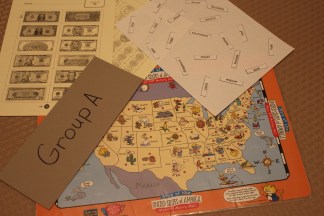

- A list of spelling words on a piece of paper (Group A) or a word ring of spelling words (Group B)
- A flat map of the U.S. (Group A) or a puzzle of the map of the U.S. (Group B)
- A book read quietly to oneself (Group A) or a book read out loud to a family member or friend (Group B)
- A number chart to 100 (Group A) or a sing-along animated YouTube video that helps children skip count to 100 (Group B)
- A page that shows examples of paper money and coins (Group A) or a play cash register with play paper money and coins (Group B)
Answer: Group B (for all the obvious reasons:))
NOTE: although the word ring is also just a list of words on notecards connected by a ring, it’s still an interactive tool because the cards are hand-held and have to be physically flipped in order to move on to the next one. Since it can be controlled by the user, I personally have witnessed how the word ring prevents Little Man from being distracted with the words he already knows (he can easily bypass them) and allows him to focus on those words that need more attention.

 degreesofmaternity.com